On this page
- Why deck board spacing matters
- Wood moves as moisture changes
- How much gap should you leave between deck boards?
- Do not forget gaps at ends and edges
- How to set consistent deck board spacing
- What if deck boards are already touching?
- Board spacing, drainage and ventilation work together
- Frequently asked questions
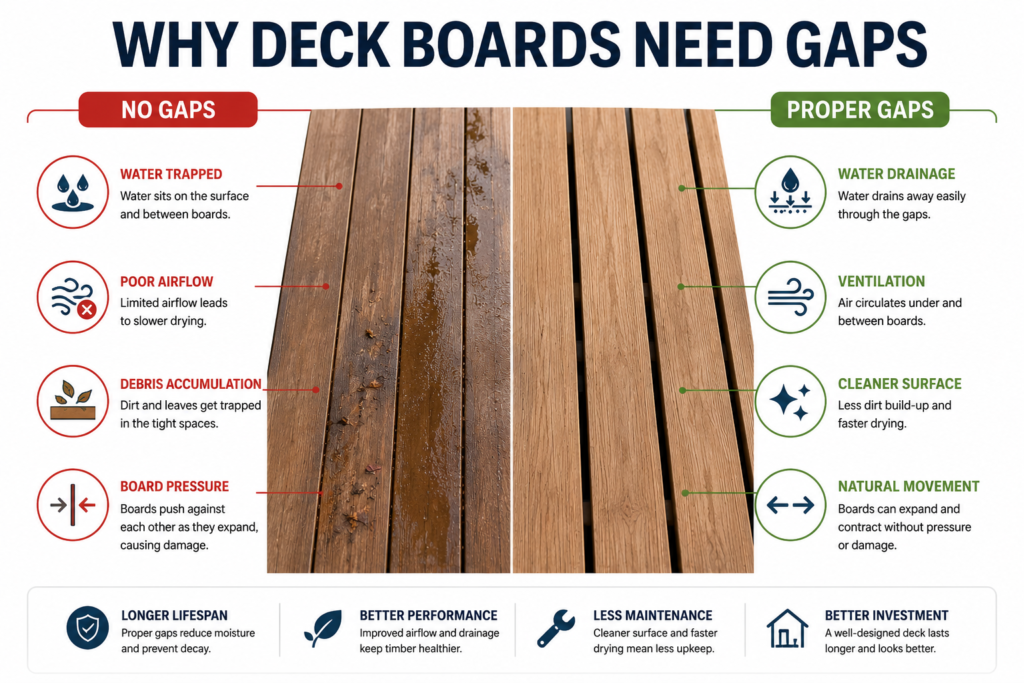
Deck boards need a consistent gap so water can drain, debris can clear and timber has room to move as its moisture content changes. For many timber decking systems, technical guidance uses a 5–8 mm gap between adjacent boards, but the board manufacturer’s installation instructions take priority. Board species, profile, moisture content and fixing system can all change the correct detail.
| Spacing condition | Likely result | What to do |
|---|---|---|
| No usable gap | Water and debris stay on the surface; boards can press together as they swell. | Do not install boards edge to edge. |
| Gap too small | The route for drainage closes easily and seasonal movement is restricted. | Use a consistent spacer that matches the board guidance. |
| Gap too large | The deck can look unfinished and small objects may fall through; board edges may feel less comfortable. | Check the product’s maximum recommended spacing. |
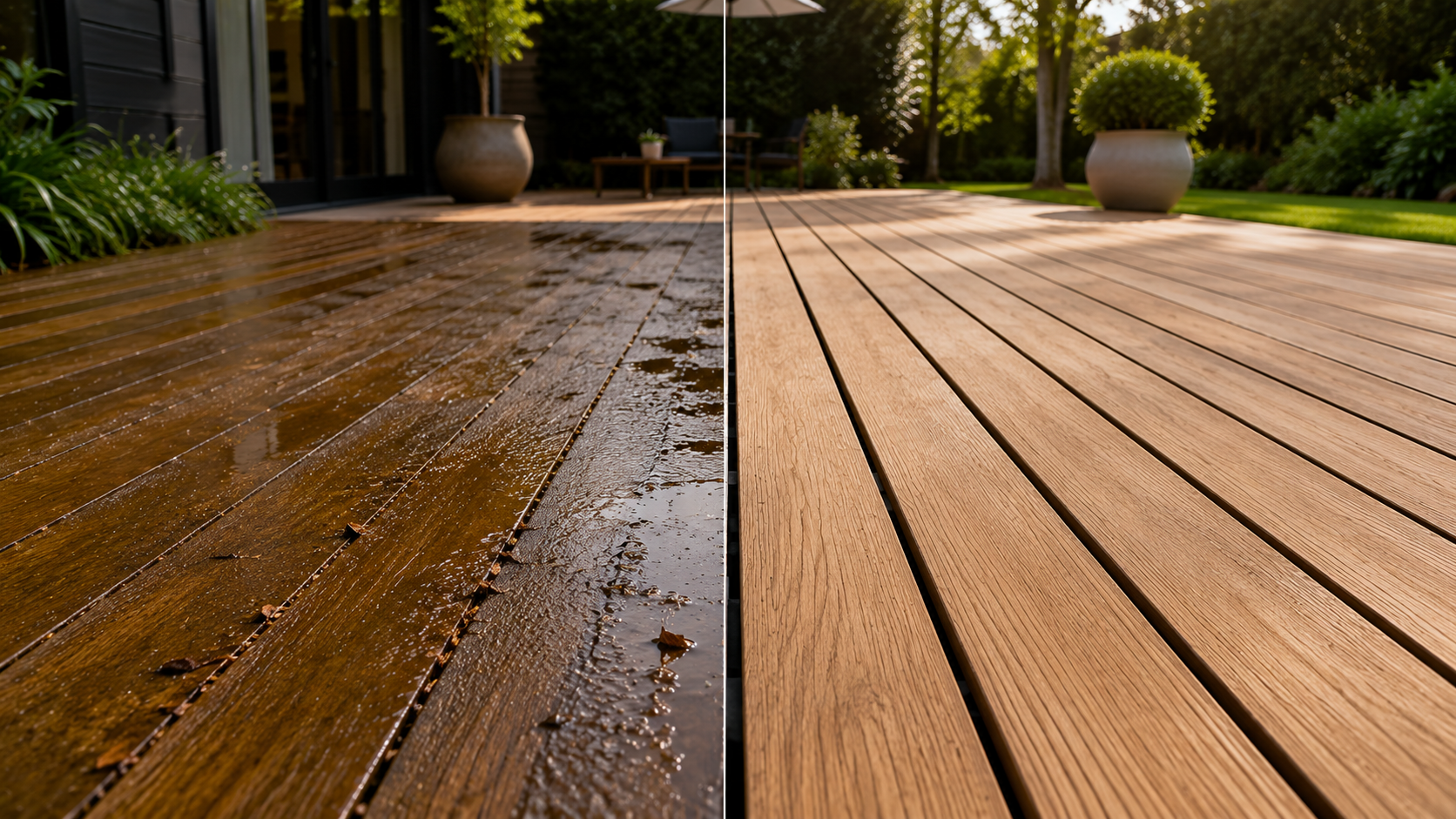
| Correct, consistent gap | Rainwater and debris can pass through while boards retain room for movement. | Maintain the gaps by clearing leaves and dirt. |
Why deck board spacing matters
The gap between boards is a working part of the deck, not a cosmetic flaw. It helps the surface shed rainwater and gives leaves, grit and small debris a route out. It also provides the movement allowance that timber needs outdoors.
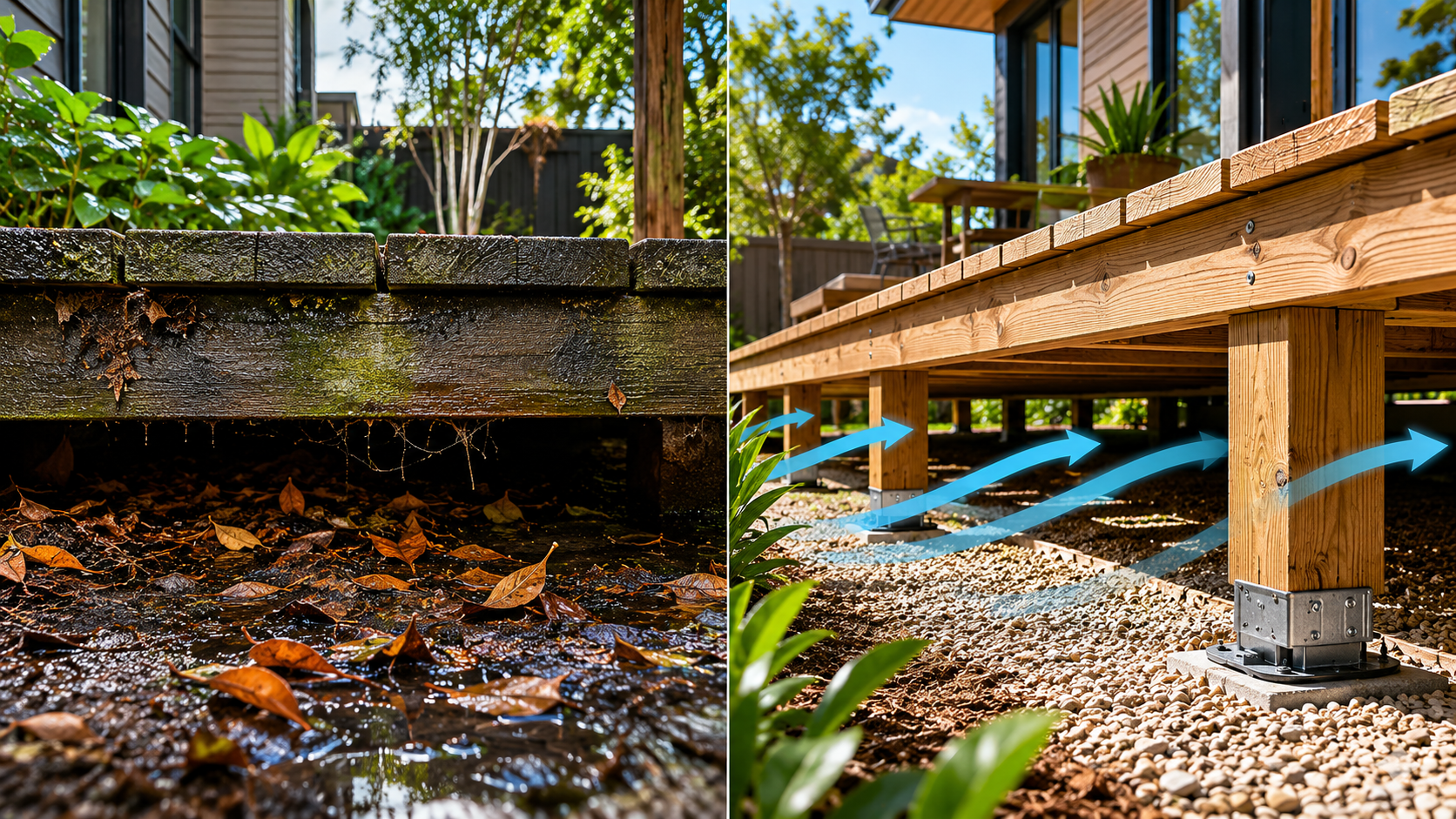
Spacing does not replace a sound structure below the boards. A deck still needs drainage away from the site and enough clearance and ventilation beneath the frame to dry after rain. It is one detail in a larger moisture-management system.
Wood moves as moisture changes
Timber absorbs and releases moisture from the air and rain. As its moisture content rises, a board can grow across its width; when it dries, it can shrink again. If boards are fixed tightly together, that movement has nowhere to go. Edges can crush together, boards can distort and the drainage route can disappear just when the deck is wet.
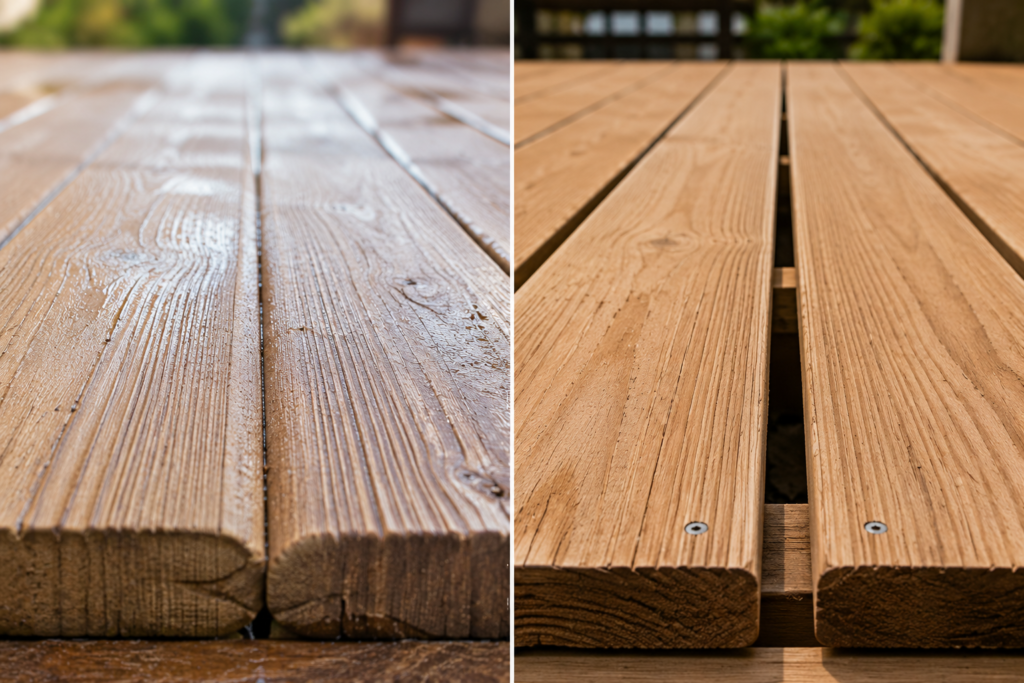
Movement varies with species, board width, treatment, exposure and how wet the material is on the day it is installed. That is why a gap taken from a different project or a social-media video is not a reliable specification for every board.
How much gap should you leave between deck boards?
Start with the board manufacturer’s instructions. For conventional timber decking, the Timber Decking and Cladding Association specification gives 5–8 mm between adjacent boards as its general guidance. It also notes that small-movement hardwoods can be fitted a little closer. This is useful as a reference point, not permission to ignore the supplied product details.
The gap should be considered with the timber’s condition. Boards installed wet may shrink as they dry; boards installed very dry may gain width during a wet season. Check the manufacturer’s stated moisture and spacing requirements before choosing spacers, especially for modified timber, hardwood and boards fixed with proprietary clips.
Do not forget gaps at ends and edges
The side-to-side board gap is only one part of the layout. Board ends need appropriate support over a joist and should not be forced tightly together. Where boards meet posts, walls or other fixed structures, leave the clearance specified for the system so water and air are not trapped at the edge.
For example, the same TDCA specification calls for a 5 mm space where a board end meets a post and a 10 mm gap beside a building. These details are specific to its timber-decking guidance, so follow the requirements that apply to your own board and construction.
How to set consistent deck board spacing
- Read the board and fixing instructions. Confirm the required side gap, end-joint detail and joist spacing for the exact product.
- Inspect the boards before fixing. Do not build with boards that are visibly distorted or soaking wet unless the supplier’s installation guidance permits it.
- Use spacers. Place the same spacer at every support line as you fix each board. Do not estimate each gap by eye.
- Keep the gap clear. Remove any offcuts, sawdust or leaves before the next board is fitted.
- Check the first few rows. Measure across several boards before continuing. A small error repeated across a deck can leave an awkward final board.
What if deck boards are already touching?
First identify why. In some cases the boards were installed with no gap; in others, dirt and moss have filled a previously adequate gap. Clear loose debris carefully with a brush or a narrow non-metal tool. Do not force a metal blade between boards if it will damage the edges or fixings.
If the boards were fitted too tightly and are lifting, buckling, holding water or repeatedly closing after cleaning, treat it as an installation problem. A contractor may need to remove and re-space boards, and any damaged fasteners or distorted boards may need replacement. Do not cut random wide slots into the surface without considering the board layout and supports below.
Board spacing, drainage and ventilation work together
Open gaps help rain leave the surface, but water also needs somewhere to go after it reaches the ground beneath. Check that the site does not hold standing water and that the under-deck space is not closed off by soil, vegetation or stored items. For the ground layers, see What to Put Under a Deck. For the effect of drying below the frame, read Does UC4 Timber Still Need Ventilation?.
Frequently asked questions
Is a 5 mm gap between deck boards enough?
It can be, and 5 mm is the lower end of the 5–8 mm range in the TDCA timber-decking guidance. Whether it is right for a particular deck depends on the exact board, its moisture condition and the manufacturer’s instructions.
Should deck board ends have a gap?
They should not be jammed tightly together. The end-joint detail needs support over a joist and must follow the system guidance. Edge clearances beside posts and buildings are also important for drainage and movement.
Do composite deck boards need gaps too?
Yes, but do not apply timber dimensions to composite boards. Composite expands differently and is normally supplied with a specific clip system and installation table. Use that manufacturer’s instructions for both side gaps and end gaps.
How do I keep gaps between deck boards clear?
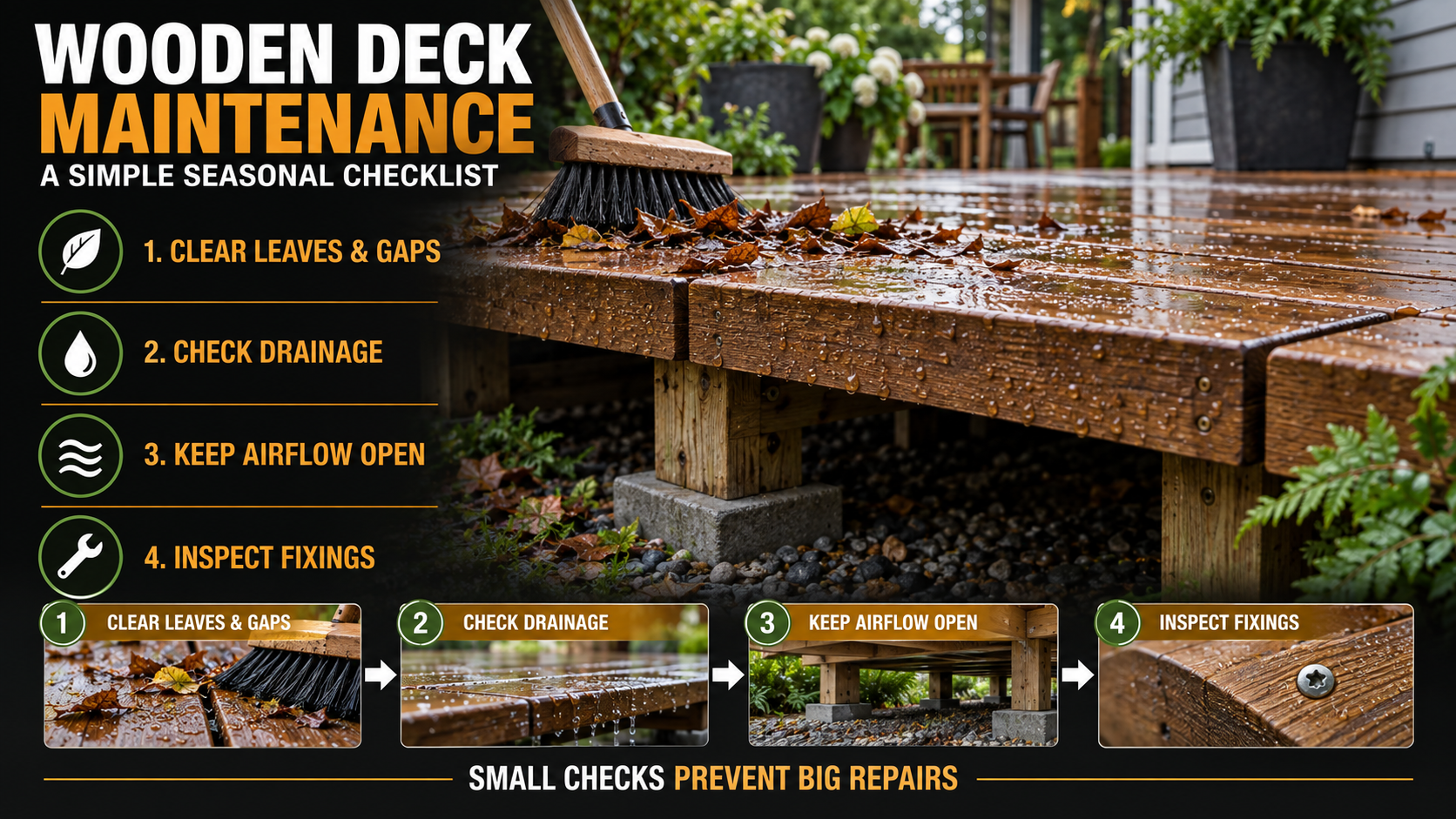
Brush away leaves, soil and moss regularly, particularly in autumn and along the deck perimeter. The wooden deck maintenance checklist explains what to inspect before small drainage problems become repairs.